GIOS M13: Remote Procedure Calls
Module 13 of CS 6200 - Graduate Introduction to Operating Systems @ Georgia Tech.
What is RPC?
Overview
A Remote Procedure Call (RPC) is a protocol-based mechanism for inter-process communication (IPC) which enables the requesting machine to execute a procedure (i.e., code) on a remote server. RPC is used to execute code on behalf of a client, while abstracting away any transfer-related details (and thus making as if the procedure is present in the client address space $\rightarrow$ local illusion).
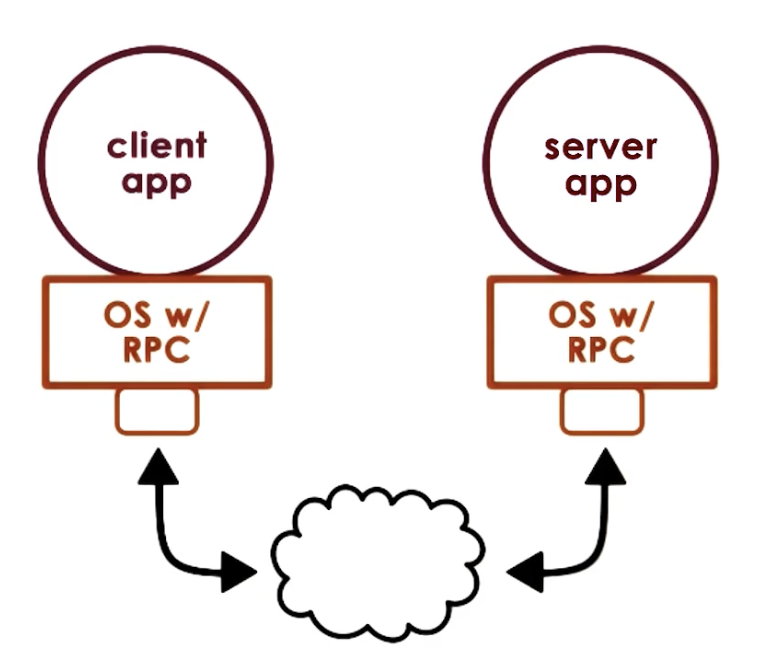
RPCs are intended to simplify the development of cross-machine (more generally, cross-address-space) interactions. They accomplish this by…
- providing a high-level interface for data movement and communication.
- supporting error handling associated with communication.
- abstracting the complexities of cross-machine interactions.
Any RPC implementation must support client-server interactions, a procedure call interface (e.g., synchronous call semantics), proper type checking, and cross-machine type conversions.
Structure
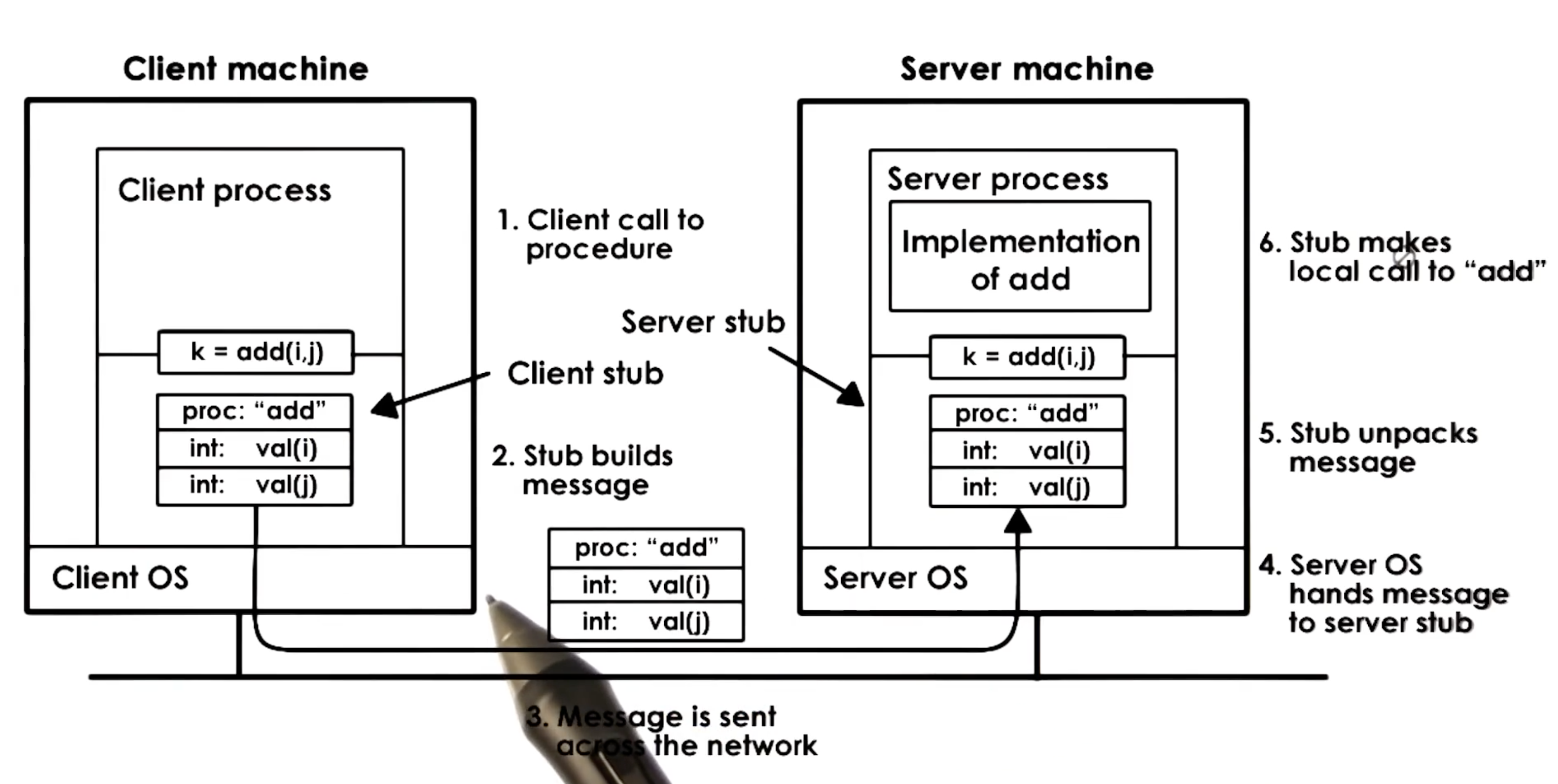
How does an RPC actually work? After the client machine makes a procedure call, the client stub marshals call specifications into a single message to be sent to the server. Upon receipt, the server stub unpacks this message and makes the relevant calls. If any responses are expected by the client, the process is reversed to transfer a return message.
Implementation
RPC Protocol
Within the client-server RPC framework, the client should only be able to call procedures supported by the server. The server must specify an Interface Definition Language (IDL) to specify its exported RPC interface. At minimum, a valid IDL must include the following:
- Procedure names, associated arguments, and result types.
- Version number; useful for identifying particular server compatible with RPC desired by client (e.g., incremental upgrades supporting older versions to avoid breaking compatibility).
The IDL may be language-agnostic, meaning its specification is not reliant on any particular programming language. XDR (SunRPC) is an example of a language-agnostic IDL, and is written using XDR language.
1
2
3
4
5
6
7
8
9
10
11
12
13
struct data_in {
	string vstr<128>;
};

struct data_out {
	string vstr<128>;
};

program MY_PROG {
	version MY_VERS {
		data_out MY_PROC(data_in) = 1;
	} = 1;
} = 0x31230000;
Conversely, Java Remote Method Invocation (RMI) is an IDL written in Java.
1
2
3
4
5
public interface Hello extends Remote {
	public String sayHello(String s) {
		throws RemoteException;
	}
}
Note that choice of language for the IDL is only for the interface definition, not for the RPC implementation or invocation! The user defines an IDL to define RPC methods and custom types, which are then implemented separately on the client- and server-side.
Marshaling
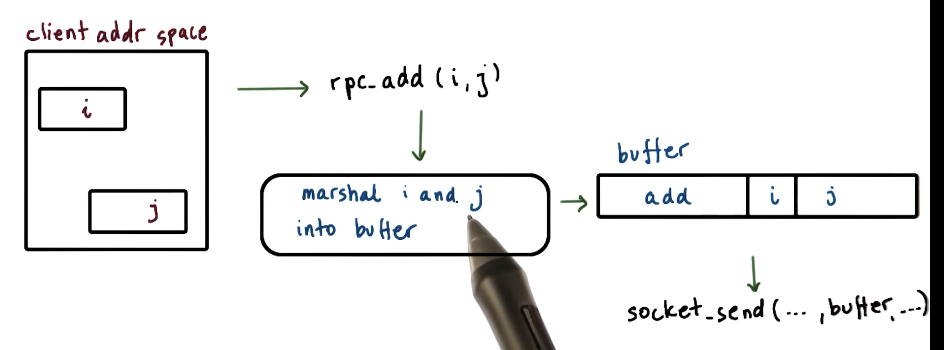
Earlier, we mentioned Marshaling - this refers to the process of organizing data into a message to be transmitted as part of RPC. More specifically, the marshaling code is responsible for serializing a client RPC method call (including call types + arguments) into a single contiguous buffer message to be sent to the server.
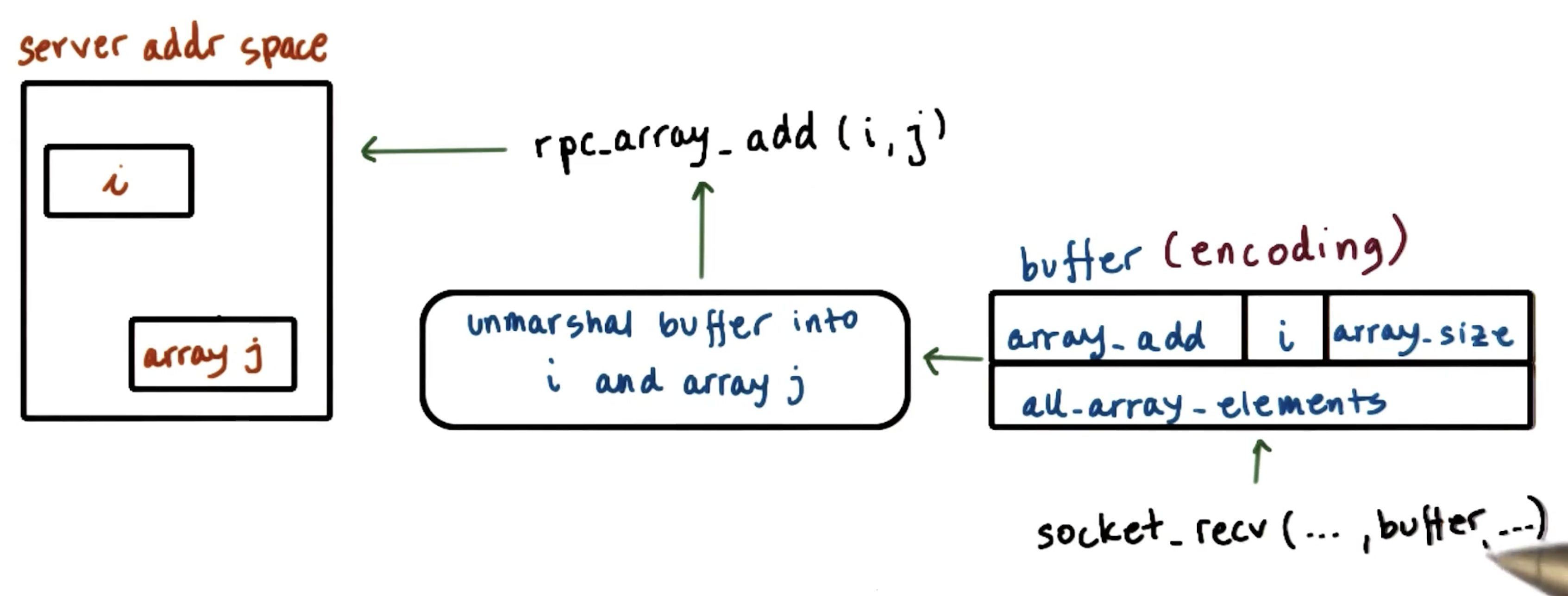
Unmarshaling involves parsing the incoming buffer to 1) identify RPC methods, and 2) reconstruct any objects on the receiving machine.
Note that the RPC user does not typically need to implement any marshaling / unmarshaling code. Instead, a given RPC library / system typically provides an RPC system compiler, which takes an IDL as input to generate marshaling / unmarshaling routines.
Binding and Registry
Binding is a client-side mechanism which involves connecting to a specified RPC server. As part of binding, the client must specify server (e.g., name + version) and connection type (e.g., IP address, network protocol, etc.).
How does a client know which servers are available for binding? The RPC system / library provides a public Registry* containing a list of all servers, as well as their associated contact details (e.g., server name $\rightarrow$ IP address) and methods.
Pointers as Arguments
Local function calls may involve pointers - variables which store memory addresses to values of interest, as opposed to the value of interest itself. Can we pass pointers as arguments to RPC methods?
1
2
3
// procedure interface: foo(int, int*)
foo(x, y);   // local procedure call  -> behaves normally
foo(x, y);   // remote procedure call -> ?
Since the pointer is an address relative to the client address space, the RPC library / system should not directly transfer the pointer value from client to server. Instead, it can make one of two implementation decisions:
- Option 1: prohibit the use of pointers as RPC method arguments.
- Option 2: ensure marshaling code serializes pointers by copying referenced data to buffer, as opposed to pointer value itself.
SunRPC
Overview
SunRPC is an RPC package originally developed by Sun in the 1980s for UNIX (Oracle purchased Sun in 2010). SunRPC makes the following design choices:
- Binding $\rightarrow$ per-machine registry daemon.
- IDL $\rightarrow$ language-agnostic definition written in XDR for interface specification and type encoding. Interface is defined within
.xfile, andrpcgencompiler converts this file to language-specific client and server stubs. - Pointers $\rightarrow$ allowed as arguments; serialized via marshaling code.
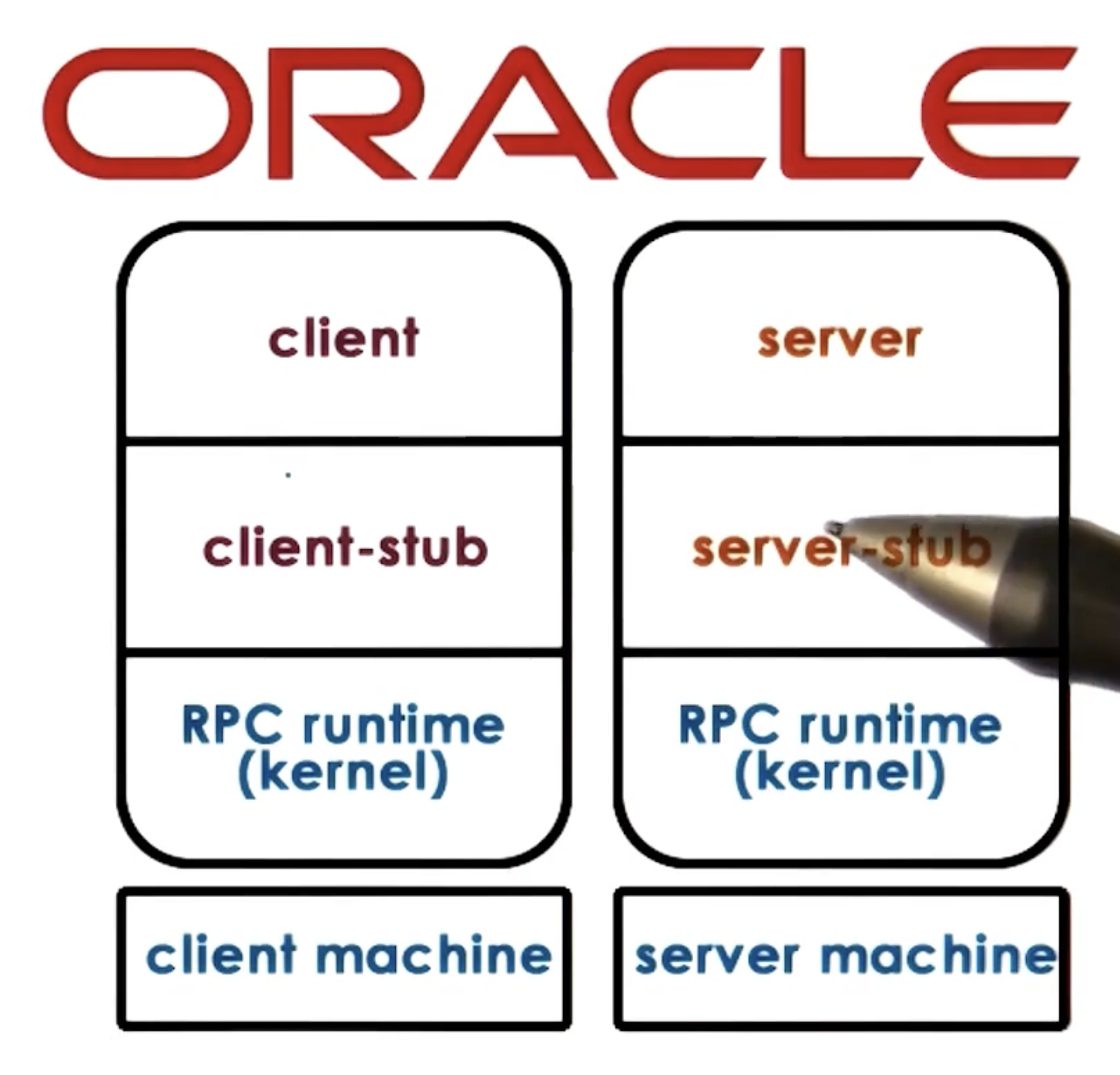
SunRPC uses Handles to manage per-client RPC state - a handle is created on client binding and is utilized during procedure calls.
XDR
Recall that SunRPC uses .x files written in XDR to specify the IDL. XDR stands for eXternal Data Representation, and is a standard cross-platform method used to represent data.
XDR files are structured as follows:
1
2
3
4
5
6
7
8
9
10
11
12
struct square_in {
 int arg1;
};
struct square_out {
 int res1;
};

program SQUARE_PROG { /* RPC service name */
  version SQUARE_VERS {
    square_out SQUARE_PROC(square_in) = 1; /* proc1 */
  } = 1; /* version1 */
} = 0x31230000; /* service id */
XDR files are compiled using the rpcgen compiler, which takes a .x file as input and produces client and server stubs written in the desired language. For example, rpcgen -c square.x generates client and server stubs written in C.
SunRPC Binding and Registry
In SunRPC, the registry is a daemon which runs on every single machine called portmapper. Servers register with portmapper, whereas clients query it for necessary information on the server (e.g., port number).
Clients initiate binding by invoking clnt_create with arguments for host name, desired protocol, version, and network protocol.
1
2
CLIENT* clnt_handle;
clnt_handle = clnt_create(rpc_host_name, SQUARE_PROG, SQUARE_VERS, "tcp");
(all images obtained from Georgia Tech GIOS course materials)