GIOS M15: Distributed Shared Memory
Module 15 of CS 6200 - Graduate Introduction to Operating Systems @ Georgia Tech.
What is Distributed Shared Memory?
Overview
Distributed Shared Memory (DSM) refers to a combined memory system in which components of memory are stored on separate machines. Since any distributed service involves similar concepts, much of the previous discussion on distributed file systems (DFS) is relevant here.
DSM is particularly useful in the context of scaling. Instead of scaling up a single machine to improve memory capacity, DSM systems rely on horizontal scaling to increase memory. This allows us to bypass the memory limitations of a single machine, often in a more cost-effective manner!
Peer DSM Systems
In this lesson, we will focus on the case of peer distribution - recall this implies each machine in the system both hosts and accesses at least a portion of the distributed service.
As part of peer DSM, each machine in the system owns some portion of memory and provides services (read / write) to access memory from anywhere in the system.
Implementation
DSM can be implemented at the hardware or software level:
- Hardware-Supported DSM: relies on network interconnect cards (NICs) to translate remote RAM accesses into messages, which are received and parsed by the NIC of the appropriate machine.
- Software-Supported DSM: uses OS or language runtime to translate remote RAM accesses into requests to other machines.
DSM design strategies must account for sharing granularity, which refers to the level of shared memory refresh across the entire system. Lower-level granularity (ex: cache line, variable) tends to require too much overhead; instead, higher-level granularity (ex: page, object) better suits DSM systems.
DSM Access and Consistency
Access by Application Type
DSM implementations should consider the typical expected use case to maximize performance. Use cases are grouped into three major application types:
- Single Reader / Single Writer (SRSW) $\rightarrow$ DSM provides application with additional remote memory. No considerations required for resource sharing / consistency management.
- Multiple Readers / Single Writer (MRSW) $\rightarrow$ DSM must support consistency mechanisms at the read level; every machine should see the same version of shared memory (state).
- Multiple Readers / Multiple Writers (MRMW) $\rightarrow$ DSM must support consistency mechanisms at both the read and write levels; system must enforce sequential consistency to maintain a globally consistent state.
Performance Considerations
The primary performance metric used to evaluate DSM systems is Access Latency. Since accessing local memory is much faster than accessing remote memory, it would be ideal to maximize local memory over remote memory accesses.
There are a few strategies used to maximize local accesses in distributed memory systems:
- Migration: transfers single valid copy of state from remote memory into local (requesting) machine’s memory.
- Replication: creates multiple valid copies of state and stores within local (requesting) machines’ (plural) memories.
Consistency Management
Recall that shared memory microprocessors (SMPs) maintain Cache Coherence to ensure each local cache in the system has proper and consistent state (relative to state across the entire system). SMPs use write-invalidate or write-update mechanisms, which are triggered by write operations.
Coherence operations triggered on each write would require too much overhead in the case of distributed memory. Instead, DSM may utilize…
- Push Invalidations (eager): invalidate local copies of state when remote state is written to.
- Pull Modifications (lazy): periodically pull updated state into local memory.
The exact mechanism(s) which occur on a trigger operation depend on the Consistency Model, which guarantees memory (state) changes will happen in an expected manner so long as the accessing applications follow a predefined set of rules.
- Strict Consistency: any state update is immediately visible everywhere in the system. Impossible to achieve on distributed systems due to latency associated with remote access.
- Sequential Consistency: memory updates from different processors may be arbitrarily interleaved. Given one observation of sequence, all machines in the system should observe the same sequence.
- This might be overkill in the case where different processors are involved with different regions of memory (i.e., why have such strict standards + overhead if the memory is not being jointly accessed?).
- Causal Consistency: guaranteed to detect possible causal relationships between updates. If causal relationship is detected, all machines in the system will observe the same causal sequence.
- Concurrent (non-causal) writes have no sequence guarantee.
- Weak Consistency: guarantees consistent update order once reaching a synchronization point; no order guarantee prior to this point.
DSM Architecture
Given our discussion of implementation considerations, how is DSM typically organized? A page-based distributed memory system has multiple independent nodes (machines) which contribute a portion of main memory pages to DSM. This system requires local caches for performance (latency), and a designated home node per page to drive coherence operations. Replication strategies may be used on-demand for load balancing, performance, and reliability.
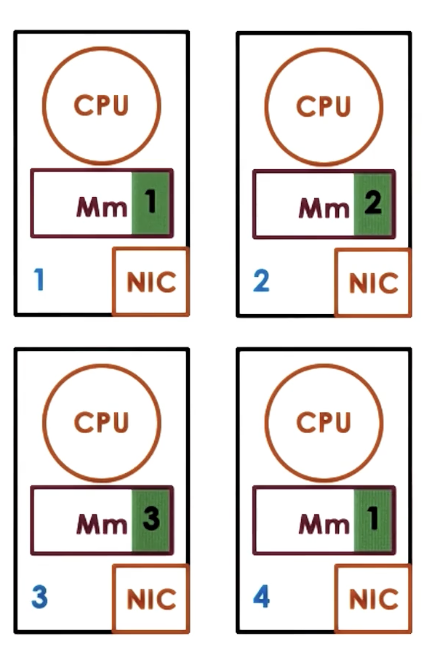
DSM must maintain metadata to index + locate pages. Each page object has an address (node ID + page frame number). A global map maps each page to its home node, and is replicated across all nodes in the system.
(all images obtained from Georgia Tech GIOS course materials)