Vienna Game
Summary of common positions + tactical motifs apparent in the Vienna Game.
Introduction
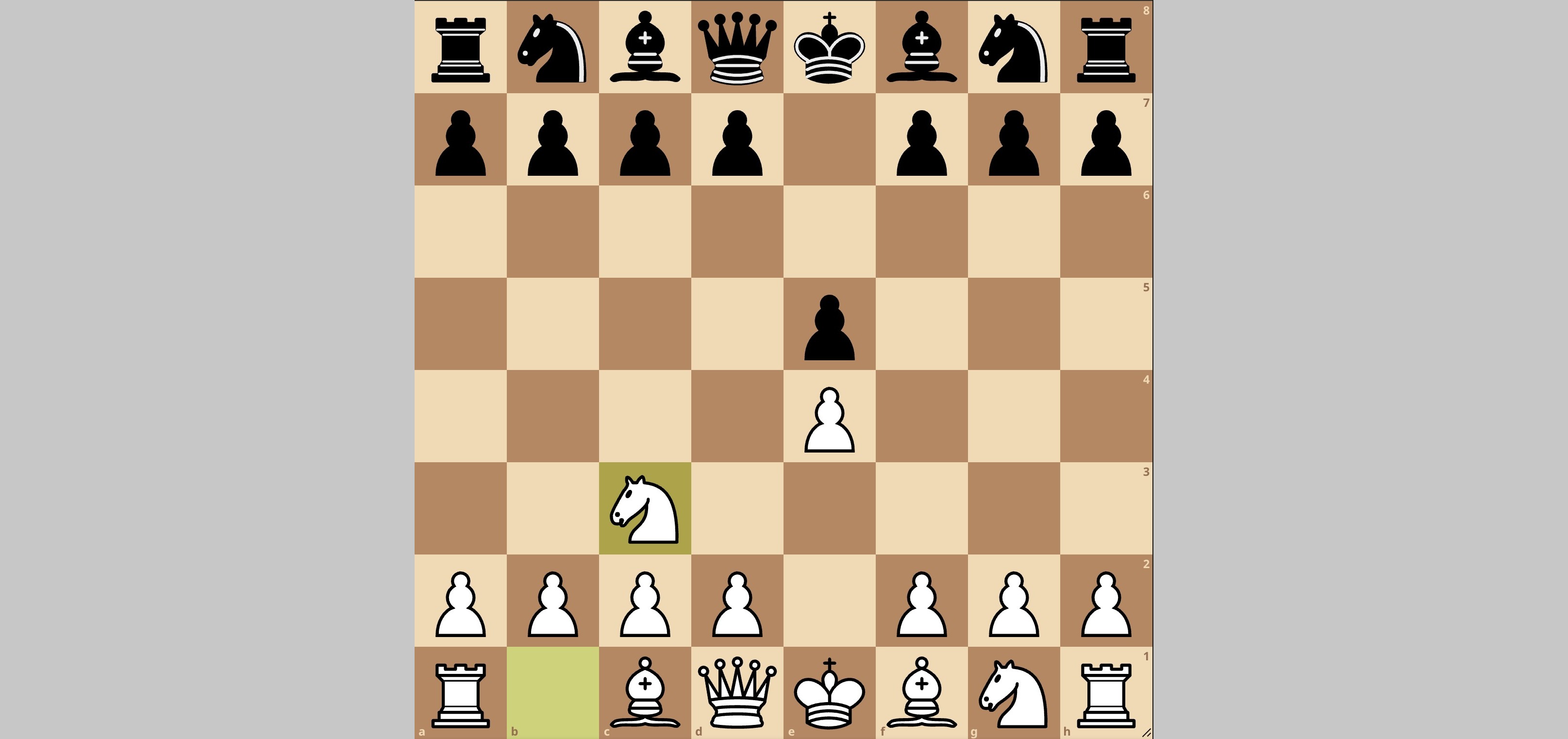
The Vienna Game is an opening which follows from 1. e4 e5 2. Nc3.
It is less commonly played compared to other openings, and tends to result in a draw at the grandmaster level. However, there are some interesting lines which cater to both aggressive and positional play styles.
Citation
Most of the insights in this post are not directly my own, but rather notes from Hanging Pawns’ YouTube series on the Vienna Game.
Section 1: Vienna Falkbeer
The Vienna Game: Falkbeer Variation results from 2... Nf6, a very natural move from black to develop their kingside knight and pressure the center. This is the most common variation at the master level (11,004 games).
Common lines extending from the Vienna Falkbeer (ranked from most to least popular) include…
3. g3$\rightarrow$ Mieses Variation. Very solid + positional.3. Bc4$\rightarrow$ Stanley Variation. Builds pressure in the center of the board, but leaves the option for aggressive or positional play.3. f4$\rightarrow$ Falkbeer Vienna Gambit. Most aggressive option, directly weakening white’s kingside in exchange for a trap-filled / threatening line.3. Nf3$\rightarrow$ transposition to Three Knights Game of Petrov’s Defense.
Mieses Variation
Let’s begin with the Vienna Falkbeer: Mieses Variation.
The primary point of 3. g3 is to fianchetto the kingside bishop and put long-term pressure in the center of the board. Black’s most popular response is to immediately strike back in the center with 3... d5. After a few captures, white should fianchetto their bishop as opposed to exchanging knights in the center.
The main line of the Mieses continues with black initiating the knight trade. White should recapture with bxc3 instead of dxc3, thereby opening the b file for the rook and pressuring black’s queenside.
Although there is much more to discuss regarding the Mieses Variation, I’d rather focus on other more aggressive lines!
Stanley Variation
As part of the Vienna Falkbeer: Stanley Variation, white brings out the kingside bishop to put added pressure on d5.
If black chooses the natural move to develop their queenside knight with Nc6, we transpose into the Vienna Max Lange Defense (discussed in the next section).
The most popular continuation of the Stanley Variation is an interesting temporary knight sacrifice with Nxe4 - this is known as the Frankenstein-Dracula Variation. However, white should not capture the “free” knight on e4, or they will face a fork and subsequent pawn push.
Instead of trading knights after Nxe4, white should instead threaten mate by playing Qh5. Black must save the knight and defend against checkmate with the awkward move Nd6. In this situation, white should preserve their light square bishop at all costs, since it has a foundational role in the kingside attack.
The Reversed Spanish Variation requires black to develop their kingside bishop instead of taking on e5. This variation is named for its resemblance to a mirrored version of the Ruy Lopez. The engine recommends white to develop their kingside knight in this position.
Finally, the Bishop’s Opening: Spielmann Attack results from 3... Bc5 4. d3. White should be prepared for black to respond with c6 - this can lead to some very tricky lines!
Falkbeer Vienna Gambit
After 2... Nf6, white can opt for an aggressive opening with the Vienna Gambit by playing 3. f4. The engine places white at a slight disadvantage in this position, but there are many opportunities for black to make a devastating mistake.
The main line in this position is a d5 counter-gambit from black, leaning to a somewhat weird exchange of pawns and lingering knight tension.
White SHOULD NOT trade off their knight in the center; instead, Nf3 and Qf3 are the primary legitimate continuations. Note that Qf3 leaves h4 undefended for a queen check from black. Although this isn’t directly problematic, it may result in damaged kingside pawn structure and perhaps an exchange of queens.
The primary continuations for 5. Nf3 include 5... Be7 and 5... Nc6. In the case of 5... Nc6, we can pin the knight with Bb5 and plan for a queenside castle.
5... Be7 is regarded as the safer move, and typically results in a knight exchange followed by queenside castle.
What happens if black doesn’t follow main line theory? First, if black decides to accept the gambit, they are immediately losing.
An even worse move for black would be to ignore the gambit with a natural move like Nc6. This is because white can advance in the center with tempo by kicking away both knights.
Black can mess up catastrophically by bringing the bishop out in response to the gambit. 3... Bc5 results in similar issues to before - white can proceed by kicking away the knight on f6 with 4. fxe5. In the case of 3... Bb4, white should again take with fxe5, and black will likely respond by trading their bishop for white’s knight. The engine prefers white to recapture with bxc3. This is atypical (we usually prefer to recapture with dxc3 to open up the diagonal for our bishop), but eventually leads to a strong center position with attacking tempo for white.
d6 is a more informed + safer move for black, where white’s goal is to eventually make a pawn break with d4. The engine has white at a $+0.47$ advantage in the resulting position.
So ultimately, most natural moves outside of the main line in the Vienna Gambit are disadvantageous for black if white has a solid game plan.
Section 2: Max Lange Defense
The Vienna Game: Max Lange Defense occurs when black decides to mirror white by brining out their queenside knight. This is the second-most popular response to the Vienna at the master level (4,294 games).
The primary lines stemming from the Max Lange Defense include…
3. Bc4$\rightarrow$ main line of Max Lange Defense.3. g3$\rightarrow$ Paulsen Variation.3. f4$\rightarrow$ Max Lange Vienna Gambit.3. Nf3$\rightarrow$ transposition to Three Knights Opening.
Max Lange: Main Line
The primary continuation of the Vienna Max Lange Defense is for white to bring out their light square bishop with 3. Bc4.
Note that if black responds by bringing out their kingside knight, we transpose to the Stanley Variation of the Vienna Falkbeer - we will consider other continuations since this was discussed earlier. Aside from 3... Nf6, the most popular move for black is to continue mirroring white with 3... Bc5.
White’s best move is to immediately strike with Qg4. Black has to be careful in this position - they must defend their pawn on g7, but a natural move such as Qf6 leads to a considerable advantage for white ($+0.84$).
If black opts for a more informed defense, we set the foundation for a longer positional battle.
Paulsen Variation
The Paulsen Variation is similar to the Falkbeer Mieses, and often transposes to Falkbeer lines.
A safe response for black is to play g6 and mirror the incoming kingside fianchetto from white. Alternatively, black may choose aggressive lines involving h5, seeking to immediately put pressure on white’s kingside.
The most common response from black is to bring out their dark square bishop with Bc5. White should respond by fianchettoing their light square bishop. White should play with the ultimate goal of forcing a pawn break with f4.
Max Lange Vienna Gambit
As opposed to the Vienna Falkbeer, white may choose to play the Vienna Gambit within the context of the Max Lange Defense.
There are two primary differences with this position relative to the Falkbeer variant. First, black does not have their knight on f6, which means accepting the gambit is not as much of a threat. In fact, the engine has black at $-0.50$ with exf4.
After natural development, black’s best follow-up is to immediately begin a kingside push with g5.
White can mess up in a TON of ways here. For example, something like 5. d4 is met with 5... g4, forcing white to move their knight and lose the d4 pawn. Instead, white’s best choice is g3. However, the engine still favors black in this position ($-0.50$).
By playing the Max Lange Vienna Gambit, we are relying our success on a poor response from black. However, if black knows what they’re doing and plays exf4, we are in an undeniably worse position. Therefore, it’s probably best to avoid this variation completely!
Section 3: Anderssen Defense
The Vienna Game: Anderssen Defense is played much less frequently than the aforementioned Vienna variations (913 games), but is common at the mid-rated level.
The engine favors white in this position ($+0.45)$, but white should take care to play the proper moves to maintain this edge. White’s main responses to the Anderssen Defense include…
Nf3$\rightarrow$ Main Line Anderssen Defense.Qh5$\rightarrow$ still considered Anderssen Defense, but not main line (trap-oriented variation).Bc4$\rightarrow$ transposition to Bishop’s Opening: Boi Variation.
Main Line Anderssen Defense
The best possible response by white to the Anderssen Defense is to bring out their kingside knight with Nf3.
If black plays Nc6, we transpose to the Three Knights Opening. White should temporarily sacrifice the knight with Nxe5 in a pattern similar to that of the Frankenstein-Dracula Variation.
If black decides to play a more long-term move such as d6, Hanging Pawns recommends to force black to trade their dark square bishop for our knight.
3. Qh5
Instead of Nf3, white may choose a trickier variation of the Anderssen Defense with Qh5.
Black must defend their e5 pawn, but can blunder a few possible ways in doing so. For example, g6 results in the classic king-rook fork seen in lower-rated games. Nf6 does nothing to defend against Qxe5+.
If black defends with Nc6, we transpose to the Max Lange Defense, and take a similar approach to the main line Max Lange.
Black may alternatively defend with Qf6 - the long-term goal for white should be to attack with the knight in the center of the board and threaten Nxc7+.
With 3... Qf6, Hanging Pawns recommends an alternative line where white immediately attacks in the center with f4. Black cannot capture with the queen, or they will lose a minor piece.
Alternatively, if black accepts our gambit with exf4, we can attack with our knight in the center of the board. Black has no choice but to defend against Nxc7+, which leaves f4 open for recapture.
The best response to our gambit from black is Ne7, which is a very difficult move to see!
Section 4: Miscellaneous Moves
What if black doesn’t follow our script for the Vienna? In this section, we will explore less commonly played responses by black on move 2.
2… d6
Black may respond to the Vienna Game with 2... d6, which is a move I’ve frequently encountered in the ~1400-1800 range on Chess.com. This move corresponds to 280 games at the master level.
3. Bc4 is the most common move played at the master level ($+0.45$). White should be careful in choosing their next moves - given a solidifying move like d3, white will be forced to exchange their light square bishop for black’s knight. This isn’t losing, but might not be favorable for an endgame.
The best engine move is to immediately strike in the center with 3. d4. If black takes, white should develop naturally and eventually play for a queenside castle.
If black decides not to recapture, white should keep the tension in the center of the board. Eventually, black may develop their queenside knight - white can then advance with d5 to immediately kick away the knight.
Overall, the engine has most lines for 2... d6 as fairly equal, so be prepared for a long-term positional battle.
2... Bb4
Finally, the fifth-most common response for black at the master level is to strike our knight in Ruy Lopez fashion with the move 2... Bb4.
This will most likely transpose to the Stanley Reverse Spanish, so concepts discussed earlier are relevant here.
Personal Takeaways
I started playing chess three years ago, and began diving into openings after about a year of play. I enjoy aggressive attacking positions, which drew me to the Vienna Game - I remember watching GothamChess’ video on the Vienna Gambit and being attracted to the many possible attacking strategies. As such, I commonly played the Vienna Gambit, regardless of black’s response to the Vienna Game.
After this more in-depth analysis, I see that forcing the Vienna Gambit is NOT a great idea in certain positions. For example, it seems ill-advised to pursue the Vienna Gambit in the context of the Max Lange Defense - a mistake I’ve commonly made and regretted without understanding where things went wrong.
I’ve never played the Mieses Variation; I think I will continue this trend in the future, and opt to strengthen my play regarding other variations such as the Max Lange Defense (main line) and Falkbeer Stanley Variation.
Sources:
Chess.com Master Game Explorer Vienna Game: Mieses Variation (Hanging Pawns) Vienna Game: Stanley Variation (Hanging Pawns) Vienna Gambit (Hanging Pawns) Vienna Game: Max Lange Defense (Hanging Pawns) Vienna Game: Anderssen Defense (Hanging Pawns) lichess.org