Introduction#
Generative AI (Gen AI) is a type of artificial intelligence which has the ability to create new content. This might take the form of text (conversations), images, code, and so on. This section provides an overview of Gen AI fundamentals, and common services for Gen AI available via AWS.
Transformers#
A Transformer is a type of neural architecture, which is a specific arrangement of layers within a neural network. Transformers were introduced alongside self-attention - their underlying mechanism - in the 2017 publication Attention Is All You Need. The transformer architecture serves as the backbone of most modern Gen AI models, including Large Language Models (LLMs) such as ChatGPT.
Evolution of Transformers#
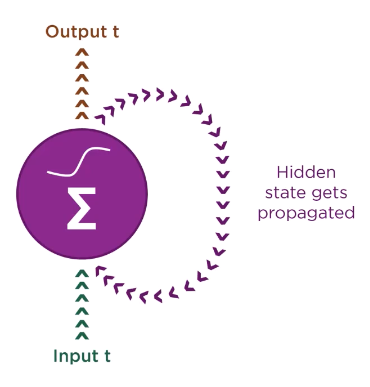
Transformers evolved from Recurrent Neural Networks (RNNs) and Long Short-Term Memory (LSTM) networks. Both of these network types utilize the concept of a feedback loop for modeling sequential items.
Machine translation took this idea one step further through the use of encoder-decoder architecture, where two separate neural networks are trained to encode and decode information.
- Encoder: takes input data and transforms into latent vector representation.
- Decoder: takes latent vector representation and transforms into output.
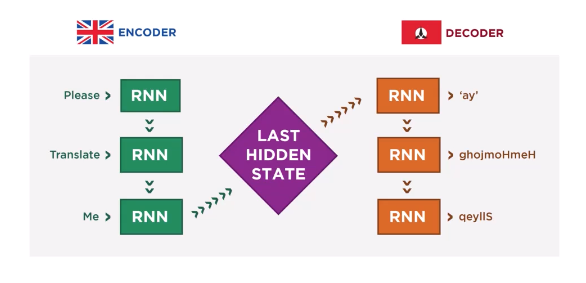
However, using one latent vector to transfer semantic understanding from the encoder to the decoder is an information bottleneck. For example, the last hidden state may not properly represent earlier terms in the input sequence, which have been iteratively overwritten by the encoder RNN. So how can we improve on this structure?
Attention-Based Networks#
Attention maintains a hidden state for each token in the sequence, and passes all hidden states from the encoder to the decoder. This is particularly useful for 1) maintaining more information on the entire sequence, and 2) representing relationships between tokens in the sequence.
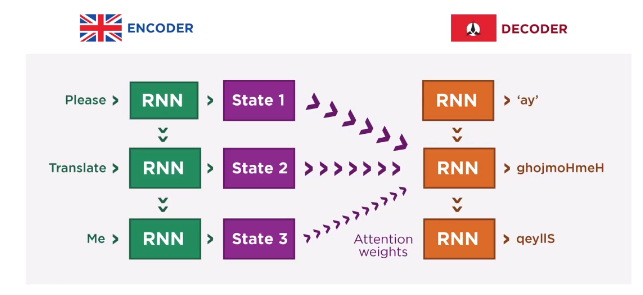
Still, the encoder’s recurrent nature is a huge bottleneck for training and inference. Each input sequence must be processed in an iterative token-by-token fashion, meaning modern efficient computing methods for neural network training (ex: parallelization) cannot be used here. Transformers replace the concept of recurrence with self-attention in combination with a Feed-Forward Neural Network (FFNN), where information flows in a single (forward) direction.
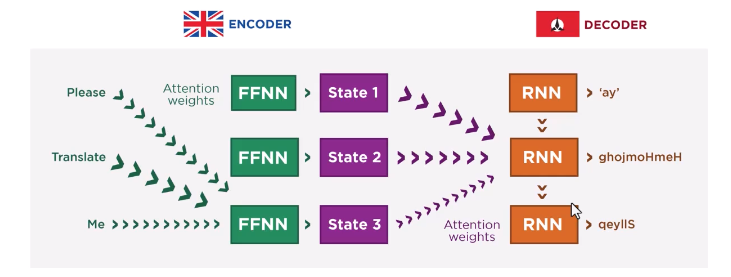
Self-Attention applies the attention mechanism within the context of a single neural network, passing the results to downstream layers (e.g., FFNN).
- The embedding layer of the encoder generates a latent vector representation (embedding) for each token in the input sequence.
- The self-attention layer of the encoder produces a weighted average of all token embeddings, where attention weights are computed from learned parameters. Each token is assigned a weighted average of learned value vectors across all tokens in the sequence.
- Three matrices of parameters are learned as part of this process. These matrices are used to produce query, key, and value vectors for each embedded input token in the sequence.
- For each token, we compute similarity between its query vector and each key in the sequence by taking the dot product of the query vector and key matrix. The result is then passed through a Softmax layer to yield scaled attention weights.
- For each token, the final output of the attention layer is a weighted average of the value vectors using its scaled attention weights.
Other variants on self-attention include…
- Masking: censoring future tokens in a sequence when computing attention weights.
- Prevents tokens from associating with future tokens in a sequence.
- This is particularly important for applications such as text generation (GPT), where information on future tokens should not be available.
- Multi-Headed Self-Attention: enables multiple patterns for attention to be learned in parallel.
Conceptually, self-attention is simply updating the original embeddings for each token to account for all other tokens in the sequence. This produces much more contextually-informative embeddings! Updated embeddings are then passed into downstream layers of the FFNN.
Applications of Transformers#
The most obvious application of transformers is conversation, including via chat (ex: ChatGPT) or question answering. Other applications include text classification (ex: sentiment analysis), named entity recognition, text summarization, machine translation, and so on. Note that transformers can be generalized to many different tasks by adding an output layer specific to the problem, such as binary classification for sentiment analysis.
GPT Models#
Generative Pre-Trained Transformers (GPT) are particular transformer-based LLMs developed by OpenAI. The first GPT model (GPT-1) was created in 2018, and subsequent versions have tweaked architecture / training to substantially improve generative performance.
GPT is a decoder-only transformer model. Each decoder block includes 1) a masked self-attention layer, and 2) a neural network. The concept of input and output is a bit nuanced here:
- Input: prompt representing a question or statement in natural language.
- Output: text generated based on previously-generated tokens and the input.
The task for GPT is next-token language modeling - it generates the most probable next token given previous tokens in the sequence. This task is commonly evaluated via Perplexity.
As with many other NLP approaches, raw input text must first be translated into a format understandable by machine learning (mathematical) models. Tokenization is the process of converting input text to tokens, where a token is a discrete ID. Token vectors are sparse, with a binary indicator in the position corresponding to the token ID.
An embedding layer converts token vectors to dense latent vectors, which are intended to capture the semantic meaning of a token. Additionally, positional encodings provide detail on the position of the token within the input sequence.
The output of a GPT model is a probability distribution over tokens. We might choose to output the highest-probability token, sample from the estimated distribution, or use a parameter called temperature to flatten the distribution (i.e., increase randomization) before sampling for token generation.
Fine-Tuning and Transfer Learning#
Transfer Learning is the process of fine-tuning a pre-trained foundation model on your specific task or dataset. There are a few methods for transfer learning:
- Train the entire model on your dataset, initializing weights to their pre-trained values.
- Add a final layer on top of the pre-trained model, freezing all other layers.
- Freeze any combination of layers within the pre-trained model, and fine-tune the others.
Fine-tuning is a much more viable strategy than training from scratch, given that foundation models have been trained 1) on massive datasets often inaccessible to the typical developer, and 2) using expensive computational infrastructure only affordable by corporations.
SageMaker Gen AI#
Preprocessing: Tokenization and Positional Encoding#
The course demonstrates how to perform tokenization and positional encoding using a provisioned EC2 Notebook Instance within SageMaker. First we review tokenization…
## hugging face (transformers) offers classes for common pre-trained models + associated tokenizersfrom transformers import BertModel, BertTokenizer
model_name = 'bert-base-uncased'
tokenizer = BertTokenizer.from_pretrained(model_name)model = BertModel.from_pretrained(model_name)
## tokenization converts input text to tokens (IDs within the vocabulary)input = 'This is my input prompt!'tokenized_input = tokenizer(input)
… and next, we review positional encodings:
## a common method for positional encoding is the sinosoidal wave function (with position in sequence as input)import numpy as np
def encode_positions(num_tokens, depth, n=10_000):  positional_matrix = np.zeros((num_tokens, depth))  for row in range(num_tokens):    for col in np.arange(int(depth / 2)):      denom = np.power(n, 2 * col / depth)      positional_matrix[row, 2 * col] = np.sin(row / denom)      positional_matrix[row, 2 * col + 1] = np.cos(row / denom)  return positional_matrix
Attention Visualized#
transformers also has a method for visualization self-attention. This allows us to understand which other tokens most closely associate with the current token in consideration, for a given input sequence.
from bertviz.transformers_neuron_view import BertModel, BertTokenizerfrom bertviz.neuon_view import show
tokenizer_viz = BertTokenizer.from_pretrained(model_name)model_viz = BertModel.from_pretrained(model_name)
show(model_viz, 'bert', tokenizer_viz, 'I read a good novel')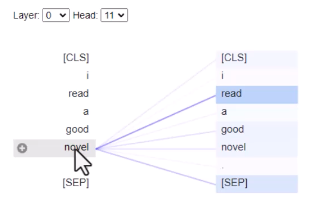
Furthermore, Explorable BERT allows us to perform this same analysis via its web application.
(all information obtained from AWS Certified Machine Learning Engineer Associate: Hands On! course on Udemy)